Give every pull request preview an OIDC client
Docs version v1 (main)Nauthera is pre-1.0, in a design-partner programUpdated
This guide deploys every open pull request of an application as a preview environment
with its own OpenID Connect client, and takes both away when the pull request is merged or
closed. An Argo CD ApplicationSet creates one Application per pull request, the
application's preview chart declares an OIDCClient named after the
pull request, and the operator registers it, delivers its secret into the
preview's namespace and removes it from the server when Argo CD deletes the resource. The
preview signs reviewers in through oauth2-proxy, so the application itself needs no
OpenID Connect code. You need a Nauthera release with its operator running, Argo CD with
the ApplicationSet controller, cert-manager with a DNS-01 issuer for a wildcard
certificate, an ingress controller, and an image built for each pull request's head
commit. At the end, a pull request labelled preview gets a URL its reviewers sign in to,
under a client nobody registered by hand, and merging it leaves no client behind on the
server. The main limit: access tokens issued to a preview's client stay valid until they
expire, so preview clients get short lifetimes.
Checked against: Argo CD 3.6.0, oauth2-proxy 7.12.0, cert-manager 1.21 and Traefik 3.7 on Kubernetes 1.37, on November 23, 2026. Every manifest on this page was applied as shown, but for the certificate's issuer, which was a private CA that oauth2-proxy was told to trust; GitHub's pull request list and the repository were served by a local stand-in. The screenshots are from that run.
The example application is billing-web, in the repository example/billing-service. Its
previews run at https:, and Nauthera's issuer is
https://auth.example.com.
| Step | Repository | What it does |
|---|---|---|
| Admit the preview namespace | Platform | One namespace, admitted once, holds every preview of the application |
| Prepare the namespace | Platform | A Group of reviewers, the wildcard certificate, the cookie key, and a policy that holds every preview client to the group |
| Write the preview chart | Application | A chart whose OIDCClient is named after the pull request and removed with it, with oauth2-proxy in front of the application |
| Teach Argo CD the client's health | Platform | Argo CD waits for the client before it starts the preview |
| Generate an Application per pull request | Platform | An AppProject and an ApplicationSet with the pull request generator |
The files, by repository:
platform-gitops/
└── previews/billing/
    ├── namespace.yaml       # step 2
    ├── argocd-cm.yaml       # step 4
    └── argocd.yaml          # step 5

billing-service/
└── deploy/preview/          # step 3
    ├── Chart.yaml
    ├── values.yaml
    └── templates/
        ├── oidcclient.yaml
        ├── deployment.yaml
        ├── service.yaml
└── ingress.yaml1. Admit the preview namespace
An organization admits namespaces by name, so a namespace per pull request would need a
change to the Organization for every one. Put all of an application's previews in one
namespace instead, admitted once: each preview's resources carry its pull request's number
in their names, so they never collide. For the main organization, add it to the chart
value operator., beside the namespaces it already lists:
# nauthera-server chart values
operator:
  enabled: true
  mainOrganizationNamespaces: [nauthera, billing-preview]
For another organization, add billing-preview to its Organization resource's
spec.namespaces; its issuer is then https:, and the
Secret the operator writes carries whichever applies, so the preview needs no change. The
operator's own namespaces (operator.namespaces) and its entry in
certManager. cover every namespace ("*") by default; if yours
are narrowed, add billing-preview to both. See
Which organization a resource configures.
2. Prepare the namespace
A preview runs code nobody has reviewed yet, under a client of your organization. Admit
only the people reviewing it: a Group in the preview namespace, which every preview
client lists in allowedGroups, so a user outside it
is refused by Nauthera before the preview sees them. Beside it go the wildcard certificate
every preview's Ingress serves, and a ValidatingAdmissionPolicy: a pull request can
change its own chart, allowedGroups and deletionPolicy included, and the policy holds
every client in the namespace to both whatever the pull request says.
# platform-gitops/previews/billing/namespace.yaml
apiVersion: v1
kind: Namespace
metadata:
  name: billing-preview
---
apiVersion: nauthera.io/v1alpha1
kind: Group
metadata:
  name: billing-reviewers
  namespace: billing-preview
spec:
  displayName: Billing reviewers
  description: Everyone who may sign in to a preview of billing-web.
---
apiVersion: cert-manager.io/v1
kind: Certificate
metadata:
  name: billing-preview
  namespace: billing-preview
spec:
  secretName: billing-preview-tls
  dnsNames:
    - "*.billing.preview.example.com"
  issuerRef:
    name: letsencrypt-dns          # your ClusterIssuer with a DNS-01 solver
    kind: ClusterIssuer
---
apiVersion: admissionregistration.k8s.io/v1
kind: ValidatingAdmissionPolicy
metadata:
  name: billing-preview-clients
spec:
  failurePolicy: Fail
  matchConstraints:
    resourceRules:
      - apiGroups: [nauthera.io]
        apiVersions: ["*"]
        operations: [CREATE, UPDATE]
        resources: [oidcclients]
  validations:
    - expression: has(object.spec.deletionPolicy) && object.spec.deletionPolicy == 'Delete'
      message: A preview client is removed with its pull request (deletionPolicy Delete).
    - expression: has(object.spec.allowedGroups) && object.spec.allowedGroups == ['billing-reviewers']
      message: A preview client admits billing-reviewers and nobody else.
---
apiVersion: admissionregistration.k8s.io/v1
kind: ValidatingAdmissionPolicyBinding
metadata:
  name: billing-preview-clients
spec:
  policyName: billing-preview-clients
  validationActions: [Deny]
  matchResources:
    namespaceSelector:
      matchLabels:
        kubernetes.io/metadata.name: billing-preview
oauth2-proxy signs its session cookies with a key, which every preview in the namespace shares; a cookie is held to its own preview's host. Create it once, outside Git, or from your secret store:
kubectl -n billing-preview create secret generic billing-preview-cookie \
  --from-literal=cookie-secret="$(openssl rand -hex 16)"
Once applied, the group is on the server, and a client that would outlive its pull request is refused:
$ kubectl -n billing-preview get groups.nauthera.io
NAME                DISPLAY NAME        MEMBERS   PHASE   READY   REASON       AGE
billing-reviewers   Billing reviewers             Ready   True    Registered   16m

$ kubectl apply --dry-run=server -f client-without-delete-policy.yaml
The oidcclients "sneaky" is invalid: : ValidatingAdmissionPolicy 'billing-preview-clients' with binding 'billing-preview-clients' denied request: A preview client is removed with its pull request (deletionPolicy Delete).
Add reviewers on the group's page in the admin dashboard (an
administrator adds other people, not their own account), or fill the group from a
directory group or an email domain with its mappers.
oauth2-proxy refuses an ID token whose email_verified is false, so a reviewer's
address must be verified: by the emailed link,
or by an administrator who creates the account as verified.
3. Write the preview chart
The application's repository holds a small Helm chart for its previews. Production keeps
its own OIDCClient under deletionPolicy: Retain, as in
GitOps & Argo CD. The ApplicationSet sets three
values per pull request:
# deploy/preview/Chart.yaml
apiVersion: v2
name: billing-web-preview
description: billing-web for one pull request, behind its own OIDC client
version: 0.1.0
# deploy/preview/values.yaml
pr: "" # the pull request's number
host: "" # pr-<number>.billing.preview.example.com
image:
repository: ghcr.io/example/billing-web
tag: "" # the pull request's head commitThe client is named after the pull request:
# deploy/preview/templates/oidcclient.yaml
apiVersion: nauthera.io/v1alpha1
kind: OIDCClient
metadata:
  name: billing-web-pr-{{ .Values.pr }}
  annotations:
    argocd.argoproj.io/sync-wave: "-1"
spec:
  clientId: billing-web-pr-{{ .Values.pr }}
  displayName: "Billing preview {{ .Values.pr }}"
  redirectUris:
    - https://{{ .Values.host }}/oauth2/callback
  postLogoutRedirectUris:
    - https://{{ .Values.host }}/
  grantTypes: [authorization_code, refresh_token]
  responseTypes: [code]
  scopes: [openid, profile, email, offline_access]
  tokenEndpointAuthMethod: client_secret_basic
  pkcePolicy: required_s256
  allowRefresh: true
  accessTokenTtlSeconds: 300
  idTokenTtlSeconds: 300
  refreshTokenTtlSeconds: 28800
  allowedGroups: [billing-reviewers]
  deletionPolicy: Delete
  secret:
generate: true| Field | Why |
|---|---|
metadata.name, clientId | One client per pull request, the same for every push to it. A push updates the preview and leaves the client as it is: re-applying a spec never registers a new client or rotates its secret. clientId is immutable, so it must not carry the commit. |
displayName | How the client reads in the dashboard and on the consent screen. |
redirectUris | Compared byte for byte, so each preview registers its own host; there are no wildcard redirect URIs. /oauth2/callback is oauth2-proxy's. |
deletionPolicy: Delete | Removes the client from the server when the resource is deleted. The default, Retain, would leave every closed pull request's client registered. |
secret.generate | The server mints the secret and the operator writes it into a Secret named after the resource, with the keys issuer, client-id and client-secret. It is never in Git. See How secrets work. |
accessTokenTtlSeconds: | Bounds how long an access token issued to the preview works after its client is gone. refreshTokenTtlSeconds may not exceed the deployment's issuer.refresh_token_ttl (720h by default). |
argocd. | Argo CD applies the client first and waits for it to be healthy, so the Deployment starts with its Secret in place (step 4). |
The Deployment runs the application with oauth2-proxy in front of it. oauth2-proxy reads
the issuer, client id and secret from the Secret the operator wrote, signs the reviewer in
through Nauthera with PKCE, and passes the application the user in X-Forwarded-User and
X-Forwarded-Email. An application that signs users in itself reads the same three keys
instead.
# deploy/preview/templates/deployment.yaml
apiVersion: apps/v1
kind: Deployment
metadata:
  name: billing-web-pr-{{ .Values.pr }}
spec:
  replicas: 1
  selector:
    matchLabels:
      app.kubernetes.io/instance: billing-web-pr-{{ .Values.pr }}
  template:
    metadata:
      labels:
        app.kubernetes.io/name: billing-web
        app.kubernetes.io/instance: billing-web-pr-{{ .Values.pr }}
    spec:
      containers:
        - name: billing-web
          image: "{{ .Values.image.repository }}:{{ .Values.image.tag }}"
          ports:
            - name: app
              containerPort: 8080
        - name: oauth2-proxy
          image: quay.io/oauth2-proxy/oauth2-proxy:v7.12.0
          args:
            - --provider=oidc
            - --redirect-url=https://{{ .Values.host }}/oauth2/callback
            - --upstream=http://127.0.0.1:8080
            - --http-address=0.0.0.0:4180
            - --reverse-proxy=true
            - --email-domain=*
            - --code-challenge-method=S256
            - --scope=openid profile email offline_access
            - --cookie-refresh=4m
            - --skip-provider-button=true
          env:
            - name: OAUTH2_PROXY_OIDC_ISSUER_URL
              valueFrom:
                secretKeyRef:
                  name: billing-web-pr-{{ .Values.pr }}
                  key: issuer
            - name: OAUTH2_PROXY_CLIENT_ID
              valueFrom:
                secretKeyRef:
                  name: billing-web-pr-{{ .Values.pr }}
                  key: client-id
            - name: OAUTH2_PROXY_CLIENT_SECRET
              valueFrom:
                secretKeyRef:
                  name: billing-web-pr-{{ .Values.pr }}
                  key: client-secret
            - name: OAUTH2_PROXY_COOKIE_SECRET
              valueFrom:
                secretKeyRef:
                  name: billing-preview-cookie
                  key: cookie-secret
          ports:
            - name: http
              containerPort: 4180
          readinessProbe:
            httpGet:
              path: /ping
port: http--email-domain=*admits whoever Nauthera admitted:allowedGroupsdecides who may sign in, before oauth2-proxy sees anyone.--code-challenge-method=S256meets the client'spkcePolicy:.required_ s256 --cookie-refresh=4mrefreshes the session before its five-minute access token expires.--reverse-proxy=truetrusts the ingress'sX-Forwarded-*headers, so oauth2-proxy sees the reviewer's address and the scheme and host they used.
# deploy/preview/templates/service.yaml
apiVersion: v1
kind: Service
metadata:
  name: billing-web-pr-{{ .Values.pr }}
spec:
  selector:
    app.kubernetes.io/instance: billing-web-pr-{{ .Values.pr }}
  ports:
    - name: http
      port: 80
      targetPort: http
# deploy/preview/templates/ingress.yaml
apiVersion: networking.k8s.io/v1
kind: Ingress
metadata:
name: billing-web-pr-{{ .Values.pr }}
spec:
tls:
- hosts:
- {{ .Values.host }}
secretName: billing-preview-tls
rules:
- host: {{ .Values.host }}
http:
paths:
- path: /
pathType: Prefix
backend:
service:
name: billing-web-pr-{{ .Values.pr }}
port:
name: httpThe Ingress takes the cluster's default IngressClass; set ingressClassName if yours has
none.
4. Teach Argo CD the client's health
Argo CD has no health check of its own for an OIDCClient, so without one it does not
wait for the client: it moves past wave -1 at once and starts the Deployment before the
Secret it reads exists.
This check reads the operator's status: Progressing until the server has registered
the client, Healthy once it has, Degraded with the server's objection when it refuses
it.
# platform-gitops/previews/billing/argocd-cm.yaml, merged into argocd-cm
apiVersion: v1
kind: ConfigMap
metadata:
  name: argocd-cm
  namespace: argocd
data:
  resource.customizations.health.nauthera.io_OIDCClient: |
    hs = { status = "Progressing", message = "Waiting for the operator" }
    if obj.status == nil then return hs end
    if obj.status.observedGeneration ~= nil and obj.metadata.generation ~= nil
       and obj.status.observedGeneration < obj.metadata.generation then
      return hs
    end
    local msg = ""
    if obj.status.conditions ~= nil then
      for _, c in ipairs(obj.status.conditions) do
        if c.type == "Ready" then msg = (c.reason or "") .. ": " .. (c.message or "") end
      end
    end
    if obj.status.phase == "Ready" then
      hs.status = "Healthy"
    elseif obj.status.phase == "Error" then
      hs.status = "Degraded"
    end
    hs.message = msg
    return hs
GitOps & Argo CD has
the same check for the other nauthera.io kinds.
5. Generate an Application per pull request
Argo CD's security notes keep ApplicationSets to its administrators, since one can create Applications in any project, so this one lives in the platform repository, beside an AppProject that lets the previews write to their namespace and nowhere else:
# platform-gitops/previews/billing/argocd.yaml
apiVersion: argoproj.io/v1alpha1
kind: AppProject
metadata:
  name: billing-previews
  namespace: argocd
spec:
  description: One preview of billing-web per open pull request
  sourceRepos:
    - https://github.com/example/billing-service.git
  destinations:
    - server: https://kubernetes.default.svc
      namespace: billing-preview
  clusterResourceWhitelist: []
  namespaceResourceWhitelist:
    - { group: apps, kind: Deployment }
    - { group: "", kind: Service }
    - { group: networking.k8s.io, kind: Ingress }
    - { group: nauthera.io, kind: OIDCClient }
---
apiVersion: argoproj.io/v1alpha1
kind: ApplicationSet
metadata:
  name: billing-web-previews
  namespace: argocd
spec:
  goTemplate: true
  goTemplateOptions: ["missingkey=error"]
  generators:
    - pullRequest:
        github:
          owner: example
          repo: billing-service
          tokenRef:
            secretName: github-token
            key: token
          labels:
            - preview
        requeueAfterSeconds: 300
  template:
    metadata:
      name: 'billing-web-pr-{{.number}}'
    spec:
      project: billing-previews
      source:
        repoURL: https://github.com/example/billing-service.git
        targetRevision: '{{.head_sha}}'
        path: deploy/preview
        helm:
          parameters:
            - name: pr
              value: '{{.number}}'
            - name: host
              value: 'pr-{{.number}}.billing.preview.example.com'
            - name: image.tag
              value: '{{.head_sha}}'
      destination:
        server: https://kubernetes.default.svc
        namespace: billing-preview
      syncPolicy:
        automated:
          prune: true
          selfHeal: true
The generator reads the repository's open pull requests with a GitHub token that can read them (a fine-grained token with read access to the repository's pull requests). Keep it out of Git:
kubectl -n argocd create secret generic github-token --from-literal=token=<token>A private repository also needs a repository credential for Argo CD to clone it, as Argo CD's declarative setup describes.
GroupandSecretare not on the AppProject's list, so a preview cannot declare who may sign in to it, and the Secret is the operator's to write, not Argo CD's.labels: [preview]builds a preview only for a pull request carrying the label. Removing the label removes the preview, as merging does.projectis a constant. A templatedprojectwould let a pull request choose which AppProject governs it.- Deletion stays on. The ApplicationSet controller deletes an Application whose pull
request is no longer open, and puts
resources-finalizer.on every Application it generates, so Argo CD deletes the Application's resources with it. Both hold under the defaults. Settingargocd. argoproj. io preserveResourcesOnDeletion:, or a controllertrue --policyofcreate-onlyorcreate-update, leaves the client registered after the pull request closes. requeueAfterSecondsis how often the generator asks GitHub for open pull requests, 30 minutes when unset. For a preview the moment a pull request opens or closes, send GitHub's pull request events to the ApplicationSet controller's webhook (/api/webhookon theargocd-applicationset-controllerService'swebhookport, not the API server's), as the generator's docs describe.
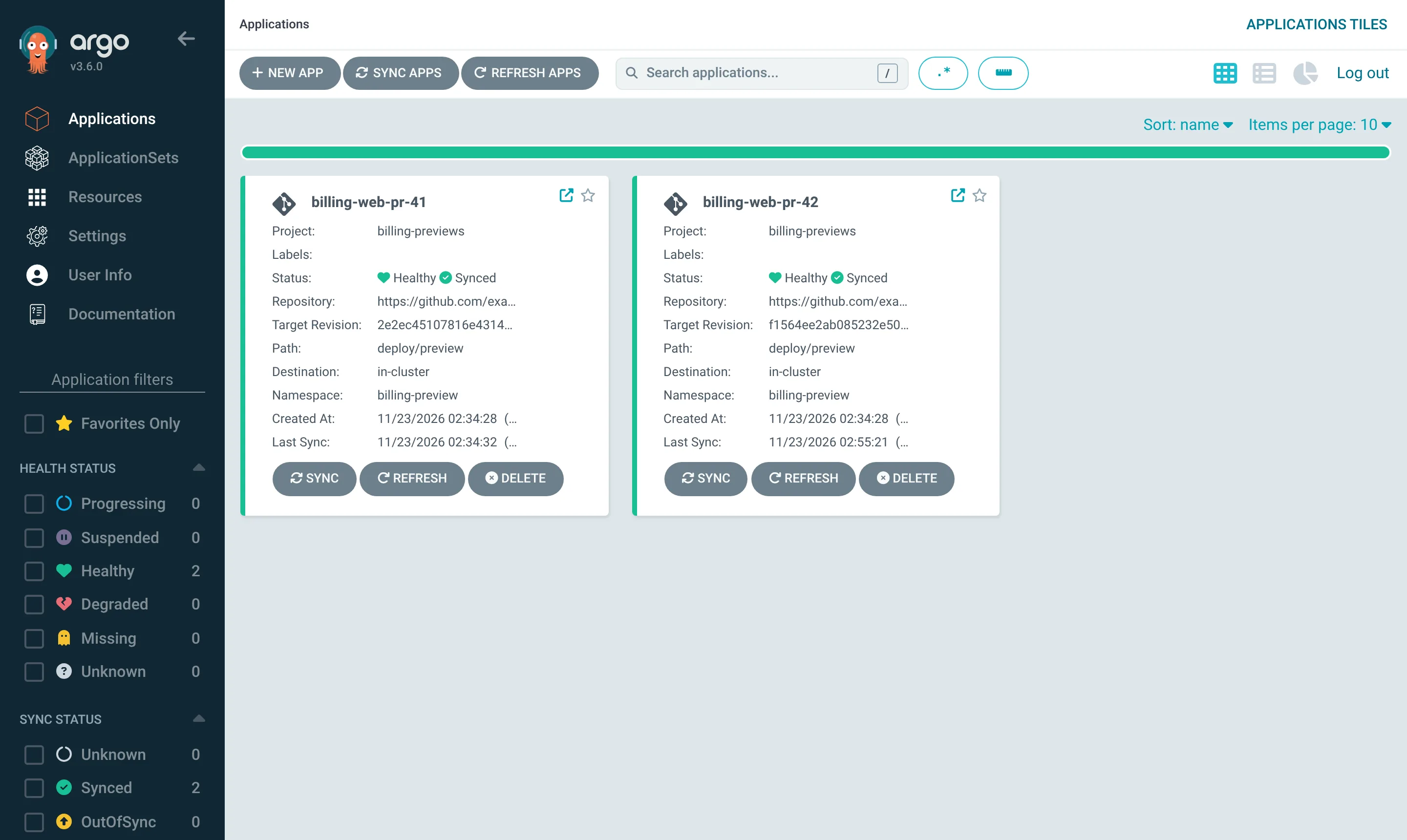
When a pull request opens
Two pull requests labelled preview give two Applications, each synced to its pull
request's head commit:
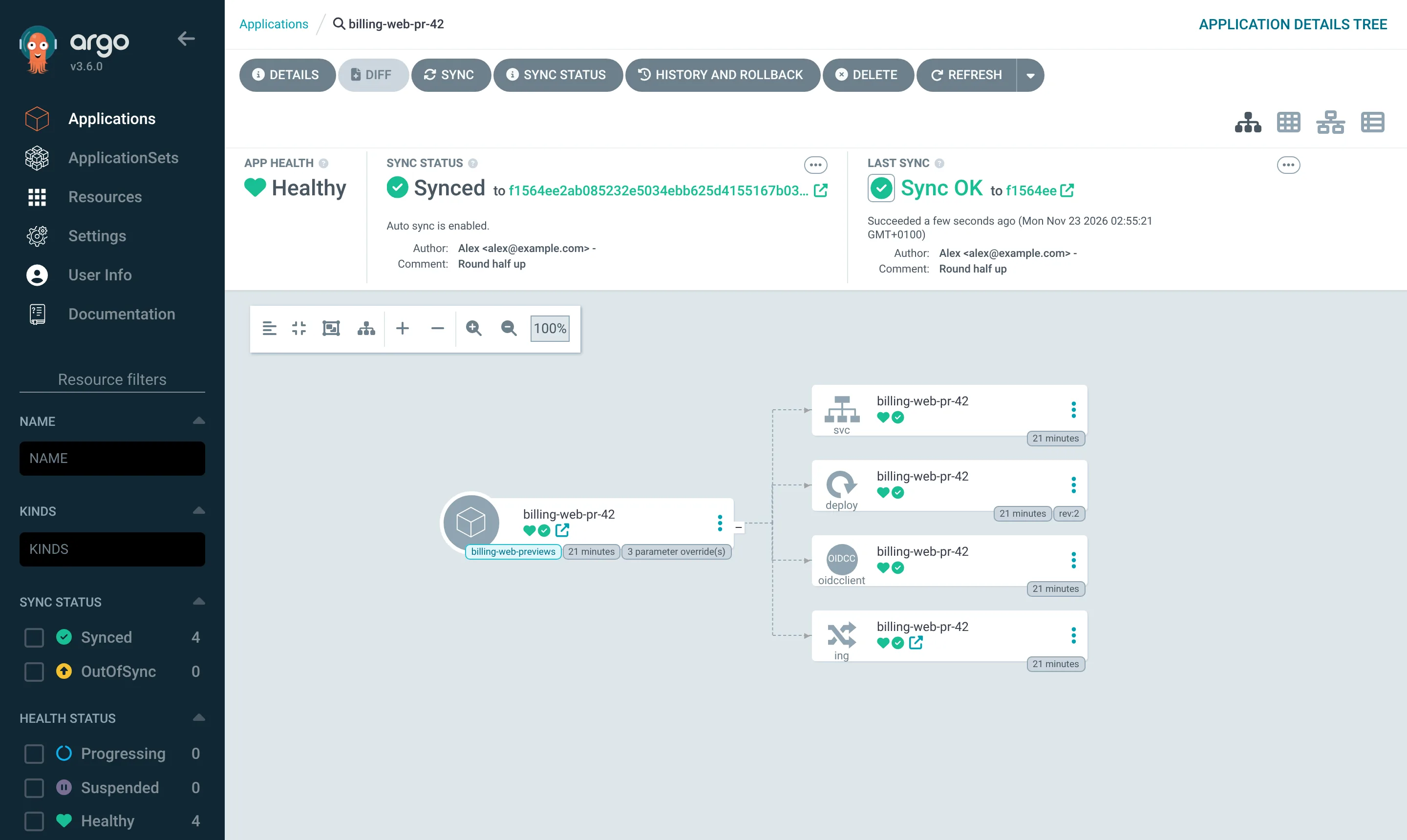
Each preview's tree holds its OIDCClient beside the Deployment, Service and Ingress, and
the health check reads it as Healthy once the server has registered it:
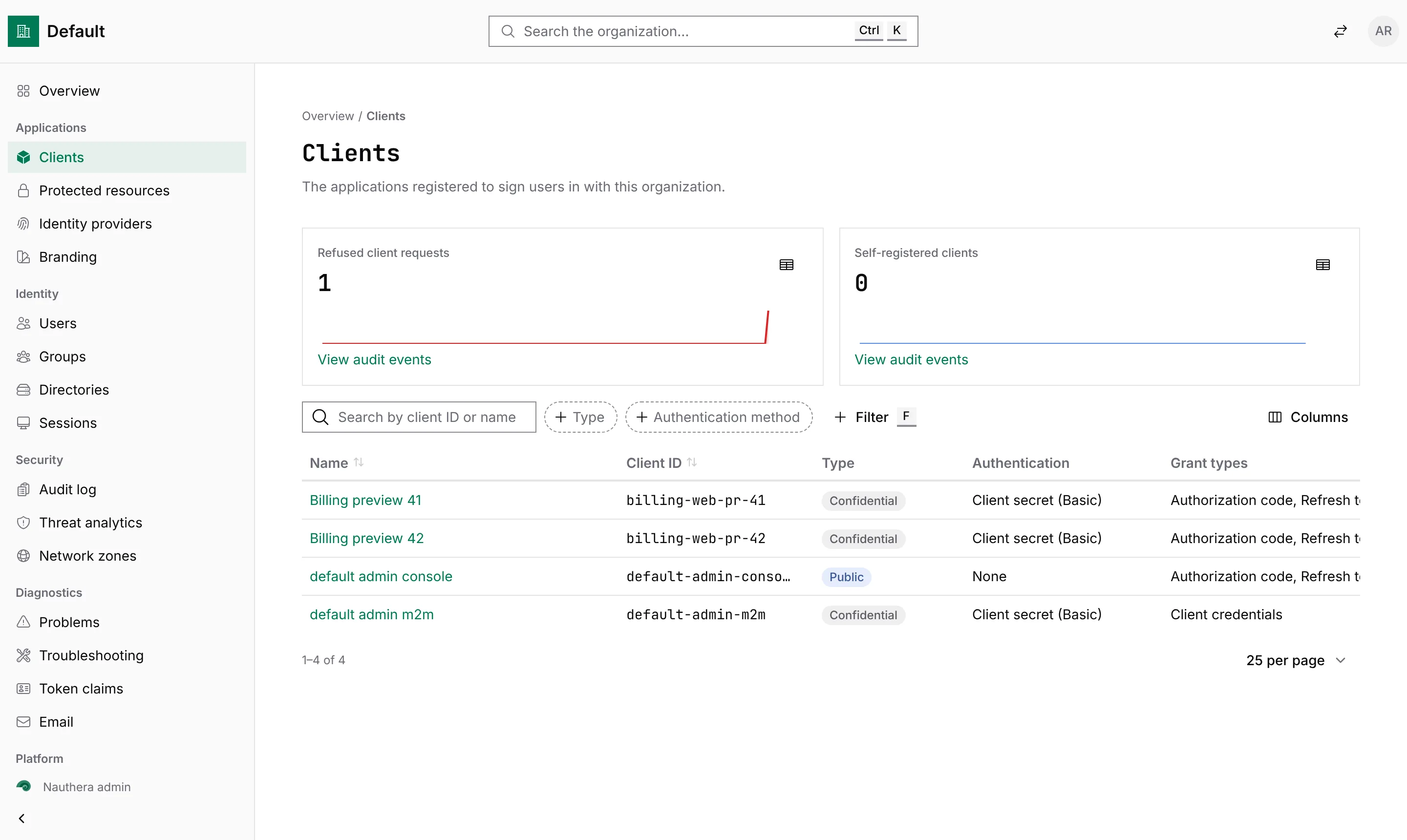
The clients sit beside each other in the namespace:
$ kubectl -n billing-preview get oidcclients
NAME                CLIENTID            AUTHMETHOD            PHASE   READY   REASON       AGE
billing-web-pr-41   billing-web-pr-41   client_secret_basic   Ready   True    Registered   21m
billing-web-pr-42   billing-web-pr-42   client_secret_basic   Ready   True    Registered   21m
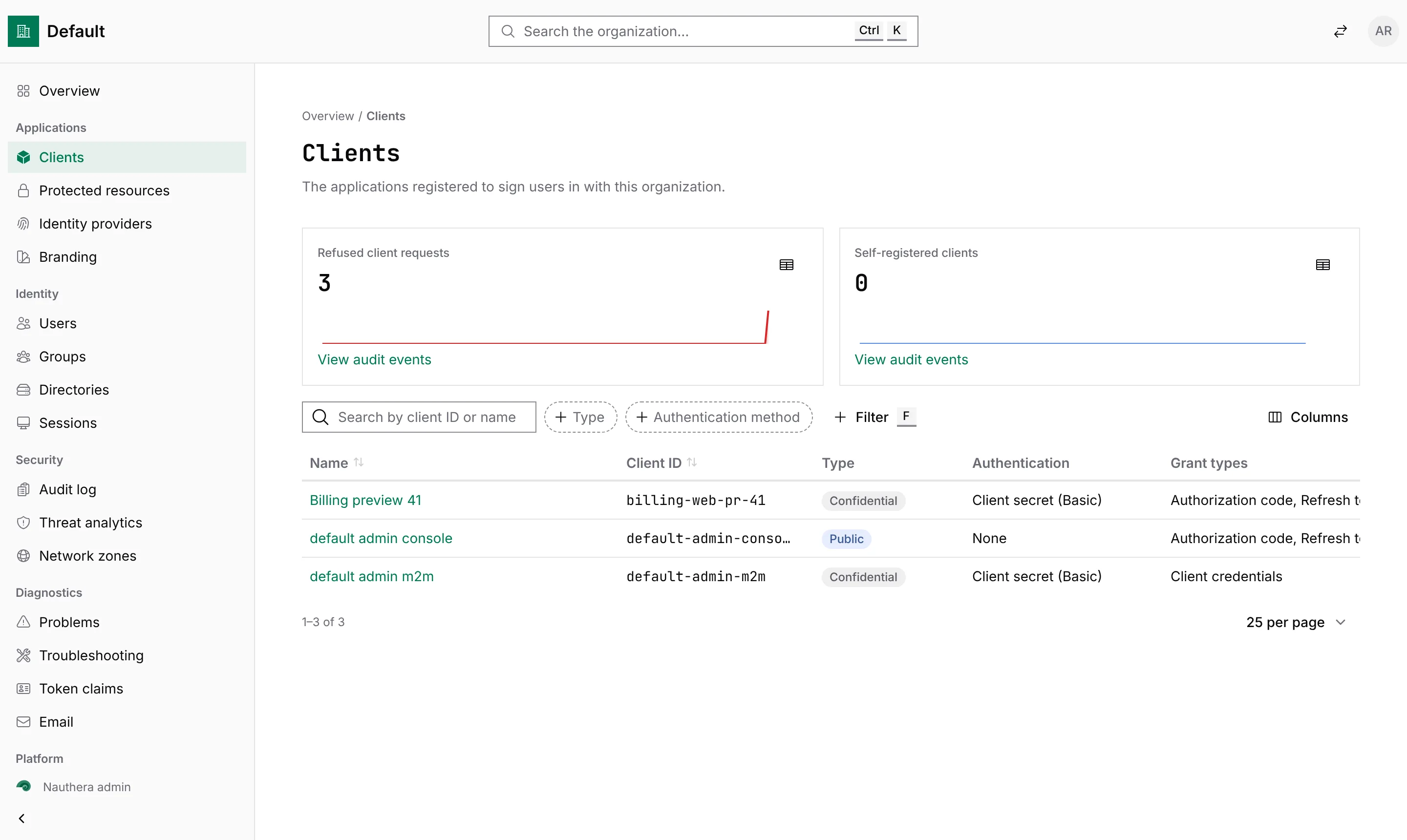
and in the organization's clients in the admin dashboard:
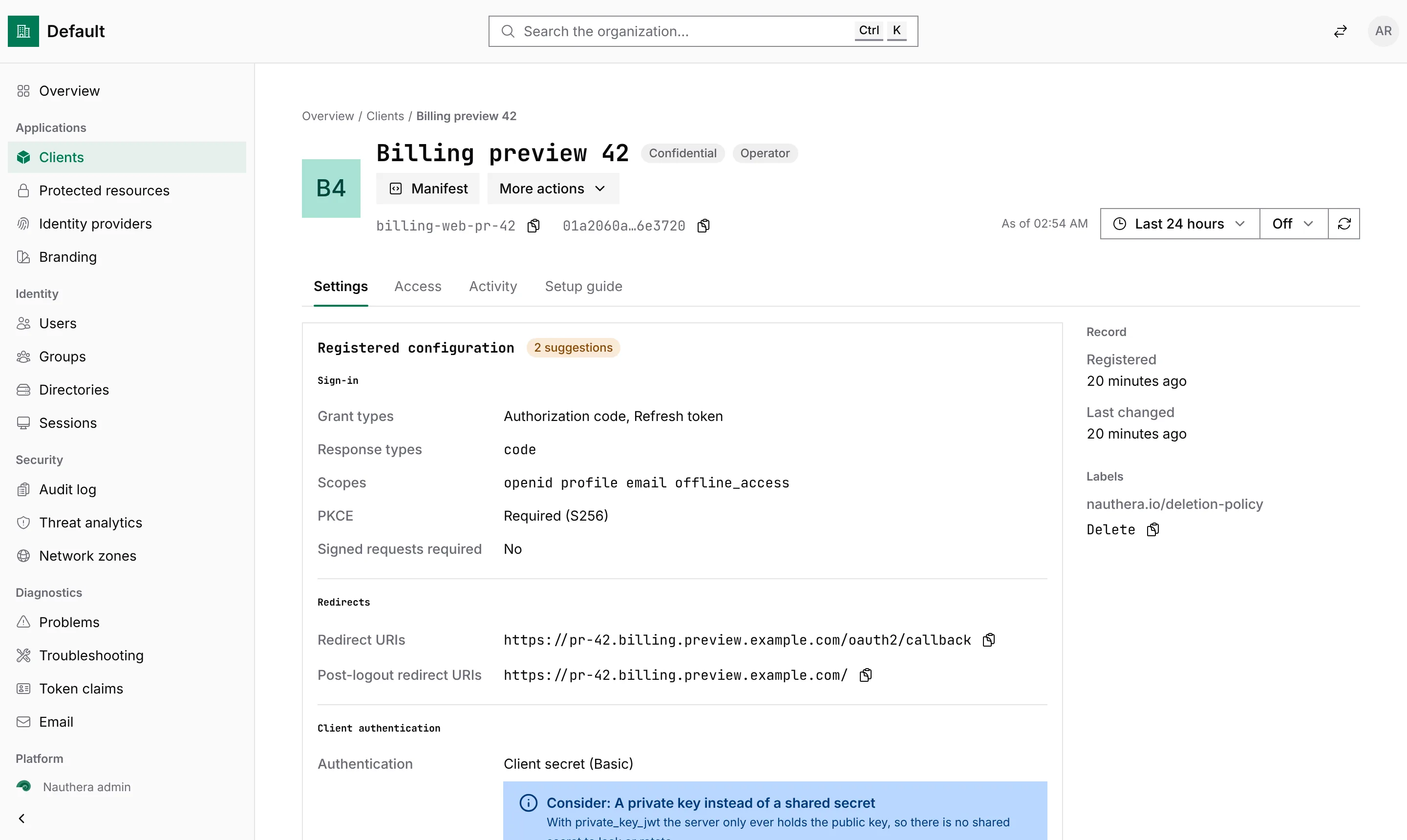
A preview's client page shows that the operator registered it, its own redirect URIs, and
the nauthera. label the operator carries to the server for its
sweep:
A reviewer in billing-reviewers opens the preview, signs in on Nauthera's pages and
lands in the application as themselves:
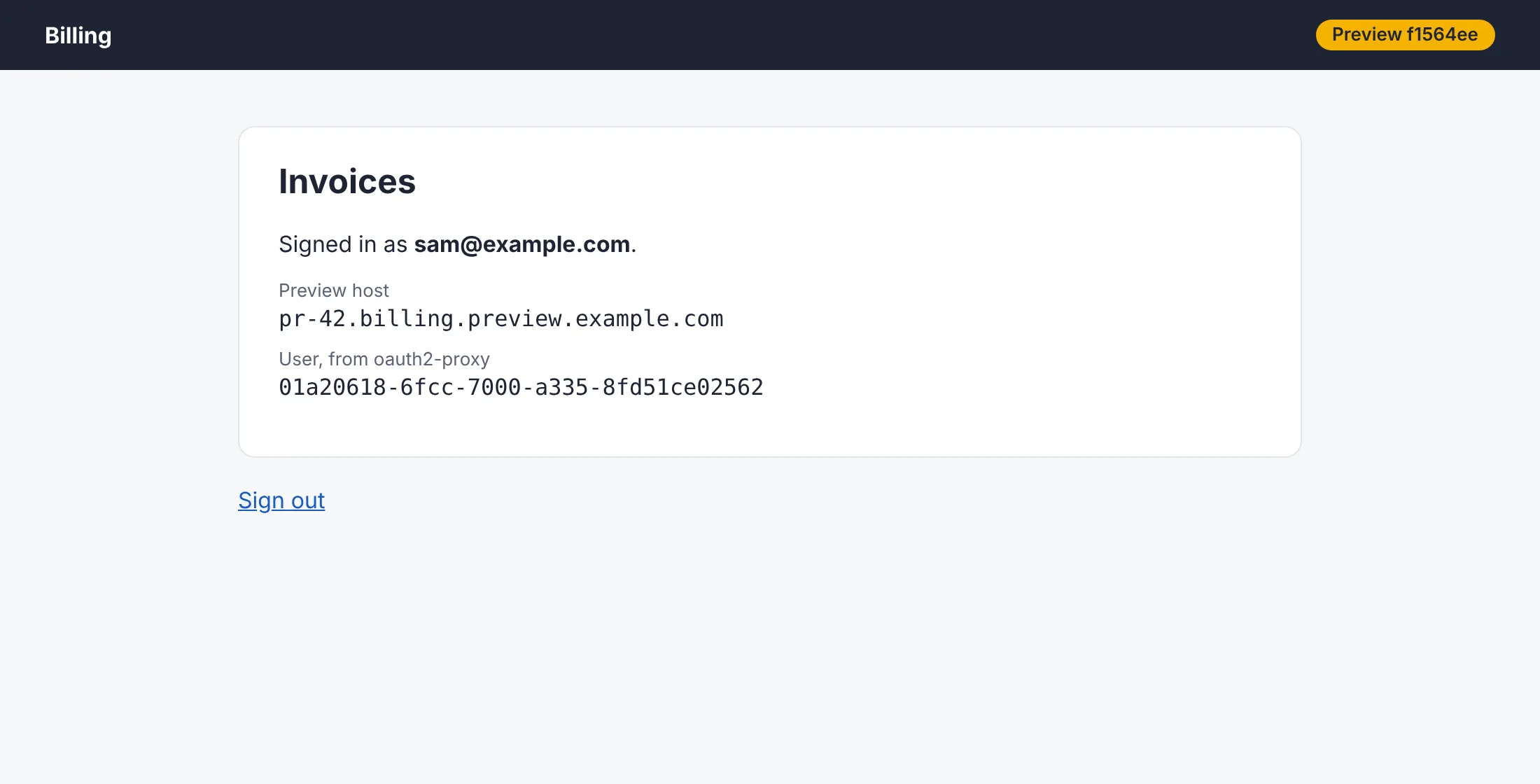
A user outside the group is sent back from the authorization endpoint with
access_denied and the description "the user may not sign in to this client", and
oauth2-proxy answers 403. A push to the pull request changes the image and syncs again;
the client keeps its revision and its secret's fingerprint.
When a pull request merges or closes
Within seconds of the generator dropping the pull request, the Application, the client
and its Secret are gone, and the operator records the removal as a Removed event:
$ kubectl -n billing-preview get events --field-selector reason=Removed
LAST SEEN   TYPE     REASON    OBJECT                         MESSAGE
1s          Normal   Removed   oidcclient/billing-web-pr-42   client billing-web-pr-42 removed from the server, as spec.deletionPolicy Delete asks
The server no longer knows the client: its credentials are refused at the token endpoint
with invalid_client, nobody signs in to it, and its refresh tokens no longer work. Access
tokens it was issued work until they expire, five minutes at most with the chart above.
The client's life, from the operator's side:
If the removal fails
A removal the server does not take, because it does not answer or refuses it, keeps the
OIDCClient in phase Deleting with the reason ClientNotRemoved, and the client stays
registered:
$ kubectl -n billing-preview get oidcclient billing-web-pr-41
NAME                CLIENTID            AUTHMETHOD            PHASE      READY   REASON             AGE
billing-web-pr-41   billing-web-pr-41   client_secret_basic   Deleting   False   ClientNotRemoved   22m
Argo CD keeps the Application, deleting, until the operator lets the client go, and names the client as the reason:
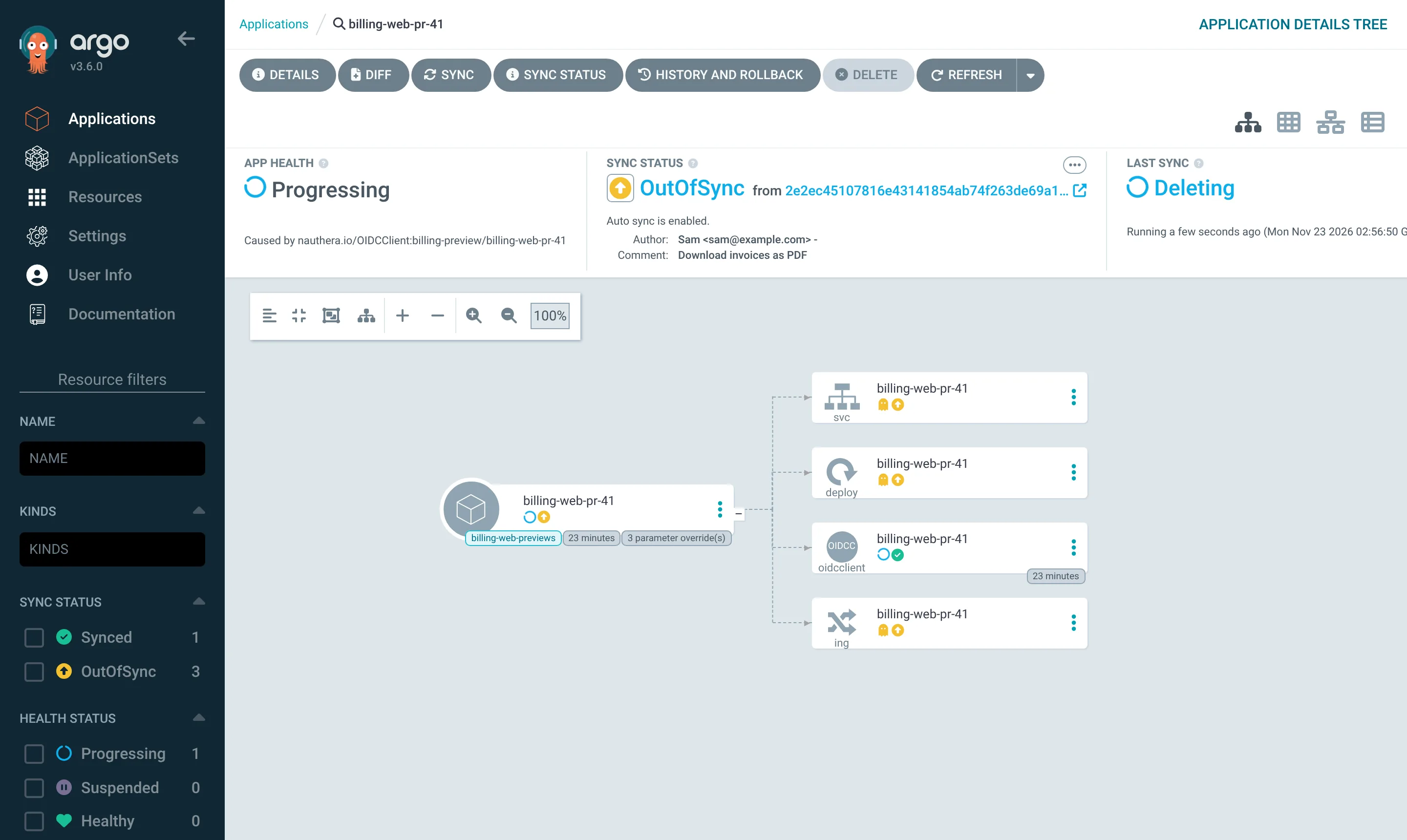
The operator retries every five minutes, or about once a minute while the server does not
answer, and finishes the removal once it does. The
ClientNotRemoved runbook says how to find the
cause. Alert on a client stuck there:
nauthera_operator_resources{kind="OIDCClient", phase="Deleting"} > 0for, say, 30 minutes. Removing the finalizer by hand lets the resource go but leaves the
client registered; the operator's hourly sweep then removes a Delete client whose
manifest is gone, once the server answers. A sweep that finds more than ten such clients
at once removes none and says so, since that is more likely a wrong listing than ten
manifests gone (Deleting a manifest).
One preview per branch
The same chart serves a preview per branch with no pull request. The SCM Provider
generator with allBranches: true and a branchMatch filter yields one entry per branch,
and the ApplicationSet deletes the branch's Application, and with it the client, once the
branch is deleted. Name the resources after the generator's branchNormalized instead of
the pull request's number. It keeps dots and runs up to 253 characters, longer than the 63
a host name's label allows, so shorten it before it names the host and the client.
Other clients a generator can own
The pattern is a generator, a template that names its client after what was generated,
and deletionPolicy: Delete. Each of these follows it:
- A client per cluster. The cluster generator renders an
OIDCClientper cluster Argo CD manages, for that cluster's Grafana or Argo CD, with its redirect URI on that cluster's host. The template's destination is the cluster the operator runs in, wherever the application runs. Removing the cluster from Argo CD removes its client. - A client per team or tenant. A list or Git generator over a file of teams, as in GitOps & Argo CD, gives each entry its client. Onboarding is a pull request adding one entry, and offboarding one removing it.
- A machine client per preview. Add a second
OIDCClientto the preview chart with theclient_credentialsgrant for the preview's end-to-end tests. The test job reads its Secret, and it goes with the pull request like the rest.
Checklist
- One preview namespace per application, admitted once by its organization.
- A
Groupof reviewers in it, with verified addresses, and aValidatingAdmissionPolicyholding every client there todeletionPolicy: Deleteand that group. - The client's
metadata.nameandclientIdcarry the pull request's number, never the commit. - Short access-token lifetimes on preview clients.
- The
OIDCClienthealth check inargocd-cm, and the client in sync wave-1. - The ApplicationSet's
projectis a constant, and nothing preserves resources on deletion. - A webhook, or a short
requeueAfterSeconds, so previews come and go with their pull requests. - An alert on
OIDCClients in phaseDeleting.